
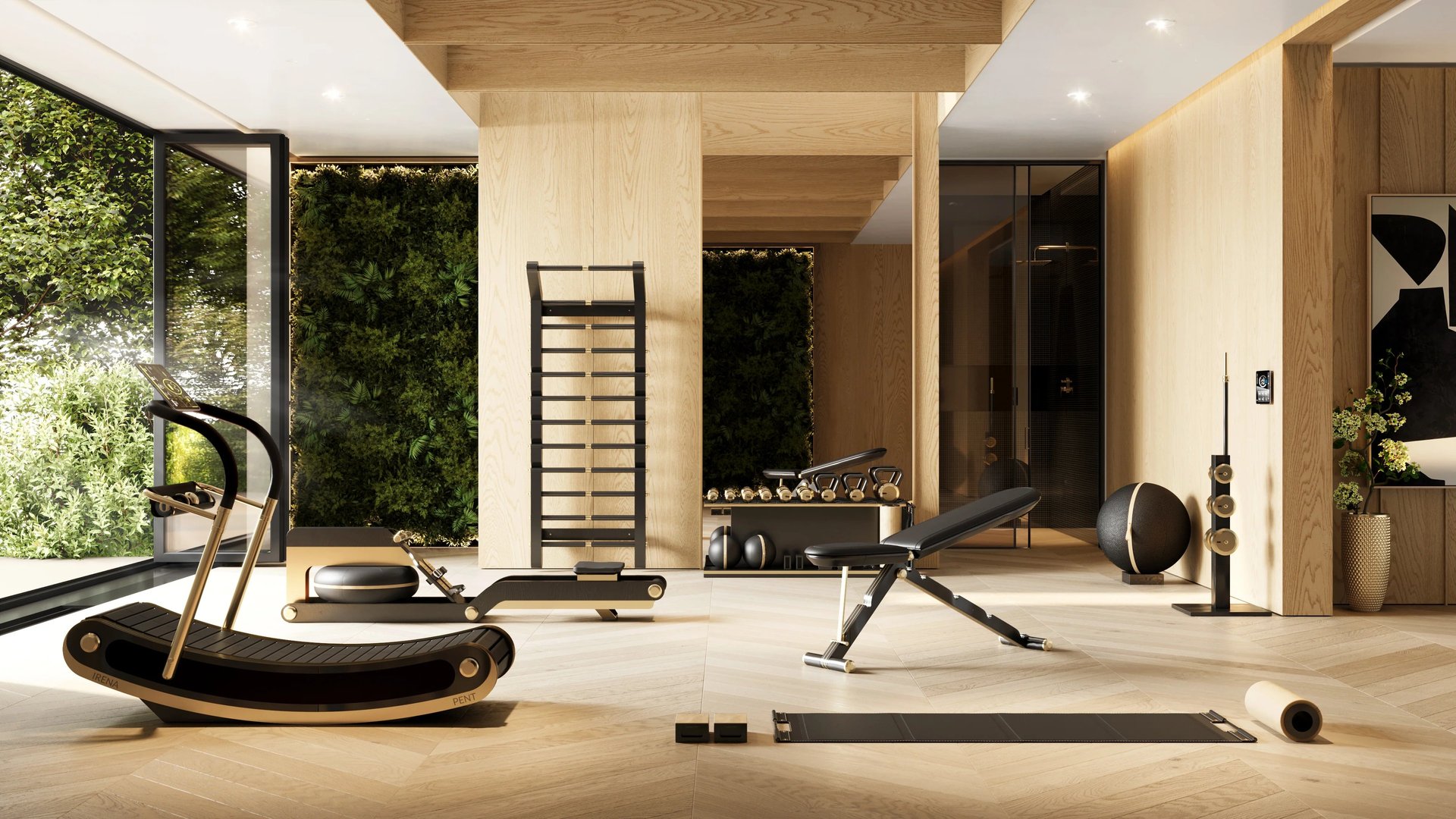
Gym Equipment Is Having a Design Moment
Celine sold out a $3,250 kettlebell. Bala bangles are on every wellness influencer's wish list. Tonal disappears into your wall like modern art. The fitness equipment industry is going through a design revolution and the psychology behind it is worth understanding.
Max Stephens
7/20/20265 min read
Last year, Celine released a Pilates fitness collection. Calfskin leather dumbbells for $2,700. A kettlebell for $3,250. A yoga mat for $1,150. A jump rope for $1,100. All finished with their signature Triomphe motif in mirrored steel, polished aluminum, and natural cork.
It sold out.
That fact alone tells you something significant is happening in how people think about fitness equipment, and the story behind it connects to psychology, interior design, behavioral science, and a pandemic-era habit shift that the industry is still catching up to.
How the home gym went mainstream
The pandemic forced a generation of people who had never owned a piece of gym equipment to build home setups almost overnight. For those with space and budget, that meant rubber flooring, a rack, a barbell, some plates, and a stack of dumbbells shoved into a corner of the bedroom or garage.
It worked functionally. It looked terrible. And for a lot of people, the visual reminder of an unfinished, cluttered workout corner became part of why they stopped using it. Equipment that gets put away doesn't get used. Equipment that feels like an eyesore in your living space tends to get put away.
The fitness equipment industry has historically operated on the assumption that performance is what people buy. Heavier, stronger, more adjustable, more features. Aesthetics were an afterthought because gyms have always been separate spaces where appearance didn't matter.
The home gym flipped that equation. When the equipment lives in your living room, bedroom, or home office, it competes visually with everything else in your space. And that changed what people wanted from it.
What the industry built in response
The most visible expression of the aesthetic fitness shift at the accessible end of the market is Bala.
Bala makes weighted bangles, bars, and rings in colors and finishes that read more like home decor than traditional gym equipment. Their products are functional, they produce real resistance, and they're priced accessibly. But the reason they've become a social media phenomenon is that they're beautiful enough that people display them rather than hide them.
That distinction matters. Equipment left out on a shelf gets used. Equipment shoved in a closet because it clashes with everything else in the room gets forgotten. Bala figured out that making equipment people want to leave out was as important as making equipment that works, and the behavioral outcome, people actually using the thing they bought, followed.
PENT Fitness took a more extreme version of the same idea and aimed it at a higher price point. Their signature piece is a complete gym modeled after a luxury drinks trolley, walnut wood, leather handles, polished metal finishes, with kettlebells, dumbbells, a medicine ball, and other equipment built into a rolling piece of furniture that looks like it belongs in a high-end hotel suite. They also make an aesthetically designed treadmill and spin bike built around the same philosophy of equipment that integrates into a designed space rather than disrupting it.
The Tonal system represents the technology angle on this shift. Wall-mounted, sleek black and chrome, with 250 pounds of digital resistance built into arms that fold flat against the wall when not in use. It doesn't look like gym equipment when you're not using it. It looks like a minimalist wall installation. That disappearing act is central to its appeal for people who want a serious training tool that doesn't dominate their living space.
The trend extends well below the premium price points. Adjustable dumbbell sets that once looked like mechanical puzzles are now arriving in clean, minimal designs. Kettlebells are being made with ceramic finishes and matte coatings. Weight plates are being designed with cutout patterns that look intentional on a shelf rather than industrial in a corner.
The psychology behind it
A 2025 Mintel survey found that a third of respondents planned to spend more on aesthetic fitness equipment specifically. That's a significant number for a category that didn't meaningfully exist five years ago.
The behavioral science here is straightforward even if the industry is only recently catching up to it. Friction reduction is one of the most reliable predictors of habit formation. Any variable that makes a behavior easier or more appealing increases the likelihood that someone does it. Equipment that's beautiful, that people are proud to have in their homes, that doesn't need to be retrieved from storage before every session, removes friction from the decision to train.
This is the actual argument for aesthetic gym equipment that goes beyond lifestyle marketing. It's not that the equipment performs better. A $3,250 Celine kettlebell and a standard cast iron one from any reputable supplier will produce the same training outcome. The argument is that people who love their equipment use it more consistently. And consistency is what produces results.
The Celine question
Celine's fitness collection is the most extreme version of this trend and it deserves direct examination.
There's an obvious version of it that's absurd. A calfskin leather dumbbell with an embossed fashion house logo is a status object, not a training tool. The people buying it are not buying it for the training outcome. They're buying it for the same reason they buy any luxury fashion item, the craftsmanship, the brand association, the aesthetic pleasure of owning something beautiful.
Whether that's a reasonable thing to spend money on depends entirely on the person spending it, and that's not a judgment worth making here.
What's interesting about the Celine collection from a market perspective is what it signals. When a heritage luxury fashion house decides that fitness equipment is worth adding to their product line, it indicates that the cultural positioning of fitness has shifted enough to make that extension coherent. Fitness isn't just a health behavior anymore. It's an identity category. And identity categories attract luxury brands.
Chanel and Pucci have made similar moves. The luxury fitness equipment market shows no signs of contracting despite ongoing economic uncertainty, according to industry analysis from mid-2025. The demand is real and growing.
The honest limitation
The equipment that performs best is still ugly black iron.
No one has made a barbell that looks like furniture and performs like a competition bar. The most aesthetically refined products cluster in the pilates, light resistance, and cardio categories where the engineering constraints are less extreme. The heavy compound movement equipment, barbells, power racks, serious plate-loaded machines, is still primarily a function-over-form category.
For serious strength athletes and competitive lifters, this is a non-issue. The garage gym with black iron and rubber flooring is the point, not a compromise. Performance is the aesthetic.
For the much larger population of people who want to train consistently without dedicating a separate room to equipment that looks industrial, the gap between what exists and what they want has been real for a long time. The industry is closing it faster than it ever has.
Somewhere between the basic rubber dumbbell and the $2,700 calfskin Celine one, there's a version of a home gym that actually encourages people to show up every day. That version is becoming easier to find, more affordable across price points, and increasingly designed by people who understand that what equipment looks like when you're not using it matters just as much as what it does when you are.
Want articles like this one delivered weekly? Join the newsletter and get a quick recap of everything we cover, straight to your inbox, once a week.

© Norva Wellness 2026. All rights reserved.
Want to be the first to hear when we publish something new?
No filler emails. No selling. We promise.